Zaki: I'm excited for this new chapter
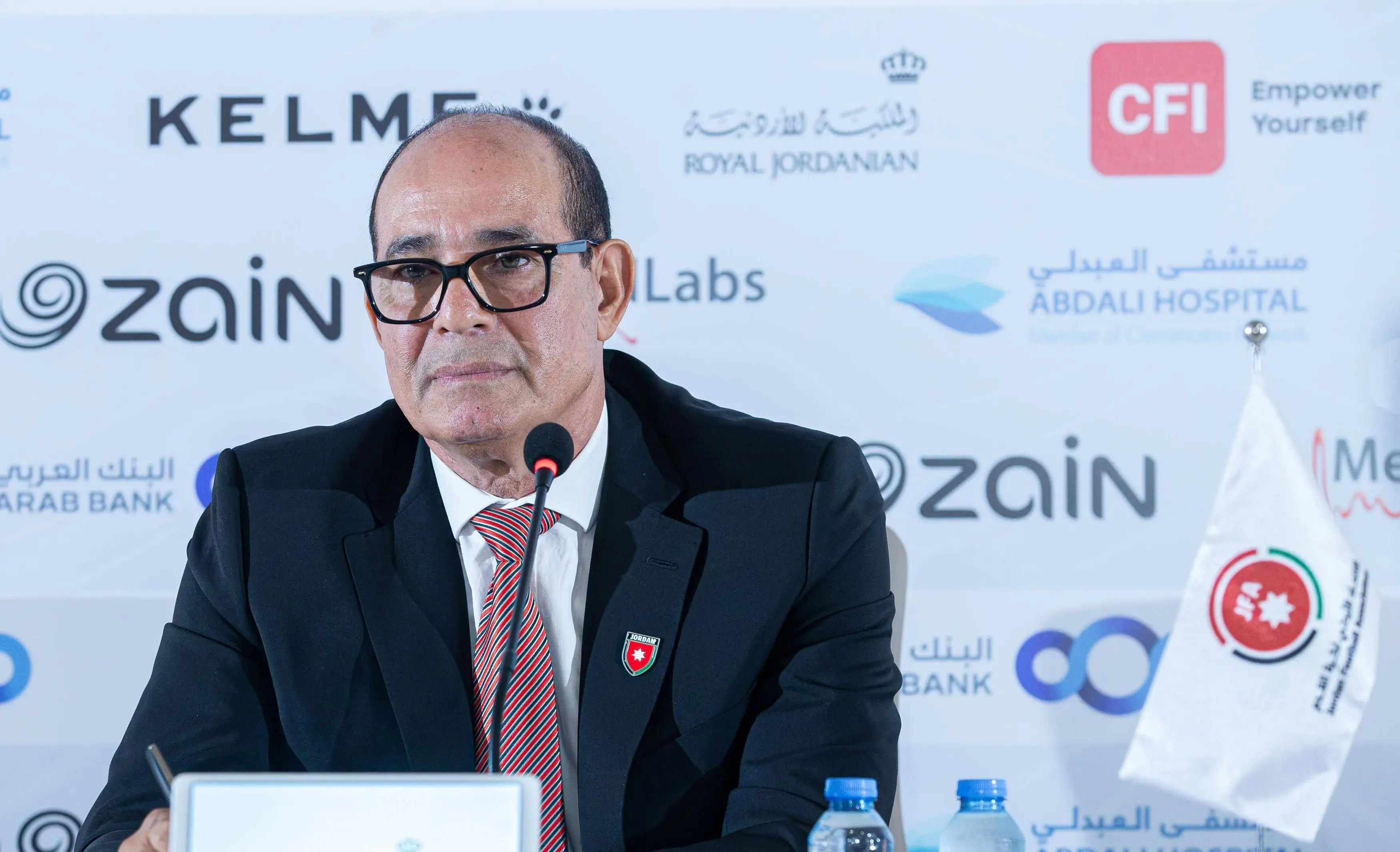
The moment the Jordanian faithful had awaited for decades came on 5 June 2025, when their national team booked a place at the FIFA World Cup 2026™. Reaching their maiden finals was no fluke, but the result of tireless work from every corner of Jordanian football. At least that is how Badou Zaki, the new coach of the Nashama, sees it.
Although Jordan exited without picking up a point at the tournament, they still left their mark by becoming the first team to score in every group-stage match at their debut World Cup.
But that was not enough to satisfy the Nashama’s ambitions, which is why Moroccan Zaki, a coach with a vast amount of experience, was brought in to carry on the work of his compatriots Hussein Ammouta and Jamal Sellami, whose tenures saw Jordan reach the 2023 AFC Asian Cup final, the FIFA Arab Cup Qatar 2025™ decider and the World Cup.
Zaki brings a CV full of achievements: taking Morocco to the 2004 Africa Cup of Nations final, leading Wydad to the 2011 CAF Champions League showpiece and winning the 2010 Moroccan league title, among other notable accomplishments.
FIFA spoke to the new Nashama boss to hear about his tactical vision and ambitions for the period ahead.
This is a new chapter in your coaching career, with an ambitious and improving side. How are you feeling about it, and what are your hopes for the future?
It’s definitely a new chapter and a new challenge for me. I’m very excited about the responsibility, especially taking charge of a team that has achieved historic things in recent years by playing in the World Cup and reaching the finals of the Arab Cup and the Asian Cup.
The development in Jordanian football in recent years is clear to see and directly reflected in the standard and results of the national team. As a result, the ceiling of the team’s ambitions has been raised, and so has the weight of responsibility. That’s why I’m proud and delighted to be coaching Jordan. We’re looking to build on what has already been achieved and put in outstanding performances in the competitions ahead of us, in particular the 2027 Asian Cup in Saudi Arabia.
How was your first meeting with the Jordan players and what was your first impression of their level?
As a matter of fact, I had followed the Jordan team for a long time, especially given what they’ve achieved in recent years, whether at the Asian Cup, the Arab Cup or by qualifying for the World Cup. So I had a good understanding of the players’ technical, tactical and individual abilities, and I knew how much the team had developed.
At this stage, we’re trying to gauge the readiness of all the players and assess the options available to us, while at the same time preserving the team’s identity, so that we end up with a side that’s organised, balanced and able to maintain the standard they’ve shown in recent years, all while continuing that development.
What are the reasons behind Jordan’s recent positive tournament results?
I believe that the team’s accomplishments are no fluke. They’re the result of an all-round renaissance in Jordan these past few years, coinciding with a special, golden generation of players. There’s a clear drive to push football forward at every level, plus improved infrastructure, a proliferation of academies, expansion of the pool for the national teams and greater attention to age-group tournaments.
The institutional work the Jordanian Football Federation is carrying out, across all its components, has also played a key role in bringing about this stage of development, and it’s coming at a time when a special generation of players have been an important addition to the national team and given it a major boost in terms of results and competitiveness.
What’s your assessment of Jordan’s first FIFA World Cup experience?
I think it was a successful and creditable campaign by any measure, especially given that it was Jordan’s first time at the World Cup. Looking at it in the right context, one sees that the team went into a very tough competition, in a group that included Argentina, the defending champions, along with Austria and Algeria, two quality teams with high-calibre players.
Considering that it was Jordan’s first time competing at this level, the team put in a good showing and demonstrated character and an ability to compete. There’s more to playing in the World Cup than the results you come away with; it gives you the opportunity to test yourself against the best footballing schools and gain experience. That’s something that will have an important impact on the team’s future.
You’ve made nine changes to the Nashama squad while keeping the team’s backbone intact. Can you explain your vision for us?
Our selections are based first of all on technical and physical readiness, as well as the team’s needs and the nature of the phase ahead. At the same time, we want to maintain the stability of the team and make use of players with experience and know-how, while giving opportunities to players capable of making a contribution.
The door is open to everyone; no one is ruled out in advance. Performance, readiness and the ability to serve the team are our criteria. Our aim is to reach the Asian Cup with as many ready options as possible, so that we can handle any circumstance or fixture that comes our way.
It’s still early, but your homeland, Morocco, is one of the countries that will host the 2030 World Cup. Do you see Jordan being among the teams at that tournament?
I think it’s premature to talk about the 2030 World Cup just yet. Our current focus is on tournaments coming up in the near future, in particular the 2027 Asian Cup. We’re working to be as prepared as possible for those matches.
The Jordan team today has considerable potential and has gained greater experience at both the continental and international level, so we have all the ingredients we need to help us reach the World Cup on a regular basis. For us, the most important thing is to take each phase as it comes, to keep working and developing, because reaching the World Cup demands consistency and long-term work.
For me personally, it would certainly be special to see Jordan at the 2030 World Cup, especially with my home country hosting the tournament. But our focus right now has to be on the work and the fixtures ahead of us – one step at a time.